
The supporting note is incomplete
Evidence may be missing, ambiguous or spread across multiple documents.
Review the documentation behind a claim before submission. Surface potential coding, authorization and clinical-evidence gaps, with a clear next action for the RCM team.
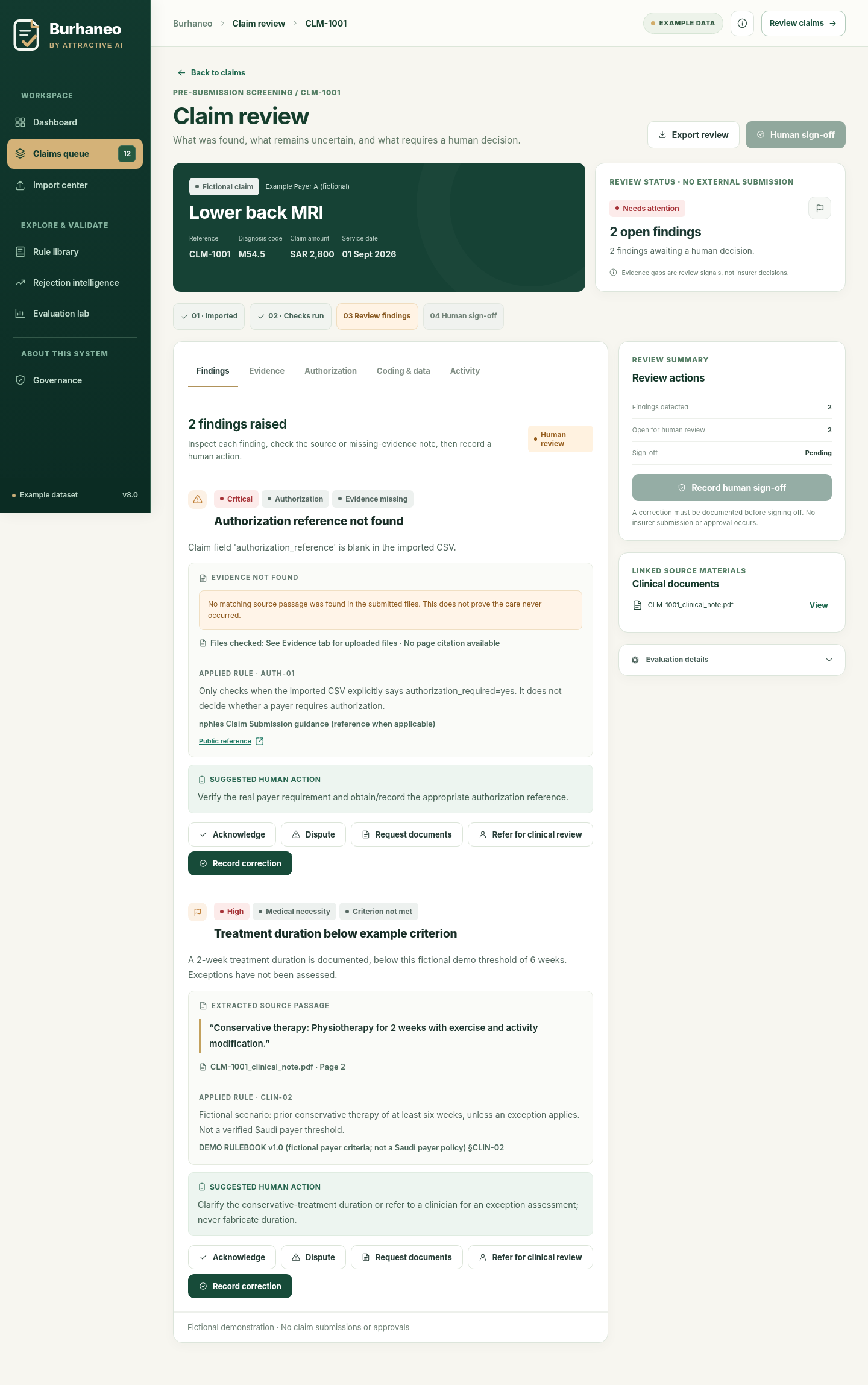
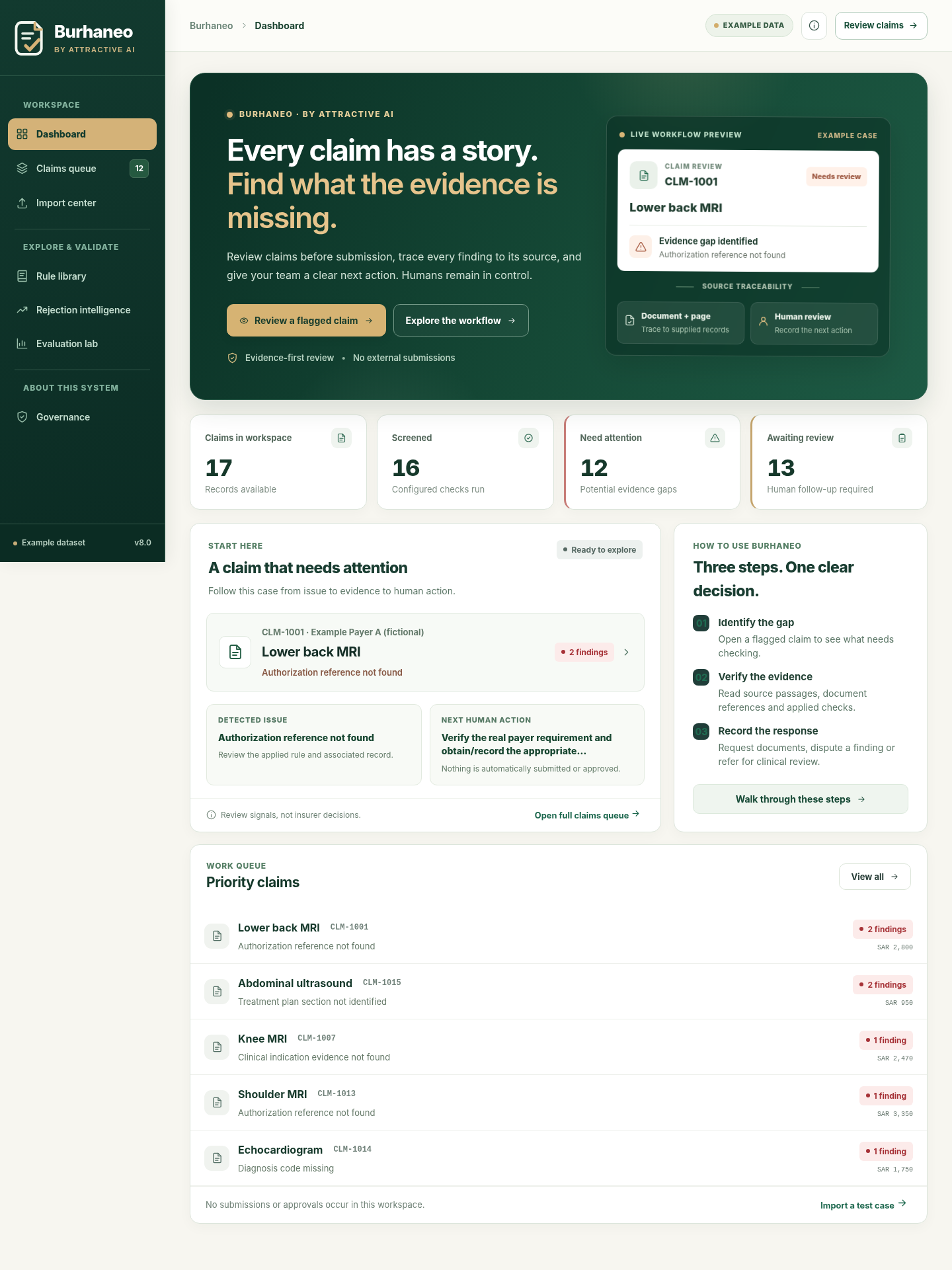
In a busy RCM department, missing clinical context, inconsistent codes and authorization gaps can stay hidden until a claim reaches the next review step. By then, staff are already paying the price in follow-up and rework.
Burhaneo is designed to bring that review forward, before submission.
Evidence may be missing, ambiguous or spread across multiple documents.
Clinical evidence, procedure coding and applicable payer requirements must be checked together.
RCM staff need to know what to request, from whom and why, before sending the claim forward.
Designed around the decisions claims specialists already make, with the supporting evidence kept visible.
Surface missing fields and potential gaps between the claim and its supporting records.
Flag selected inconsistencies for coding specialists to inspect and resolve.
Highlight authorization references or supporting information that require verification.
Compare available documentation against configured criteria without replacing clinical judgment.
Every finding is organized around the issue, rule, source and next human action.
Structure retrospective rejection analysis as historical outcomes become available and validated.
A human-reviewed process that fits before the existing submission workflow.
Import a claim and its relevant clinical documents through an approved workflow.
Apply configured checks and identify information that may be missing or inconsistent.
Give the reviewer the reason, relevant rule and exact passage or missing-evidence note.
Request documents, refer clinically or document a correction. Humans control the outcome.
Open a fictional case and follow it from a flagged issue to the relevant document passage and the reviewer’s next action. See the actual interaction, not just a slide deck.
Demonstration includes fictional cases and example rules. No real patient records.
Leo Charalampidis and Ashraf Ghaly were each working on healthcare-related ventures from different angles. Leo was building automation around the administrative work that slows providers down. Ashraf brought experience in medical claims, payer requirements and healthcare operations across Saudi Arabia, Egypt and the wider region.
Through those conversations, one problem stood out: for smaller and mid-sized providers, gaps in clinical evidence or claim preparation can be discovered only after they create another round of work. The cost is easy to overlook when it is spread across thousands of decisions.
They decided to combine product engineering with regional claims expertise to build Burhaneo: a way to flag problems earlier, show why they matter and leave every decision with the hospital team.
Founder, Attractive AI · Product, software & commercialization
Saudi/GCC healthcare, claims & payer workflow expertise
Not to replace adjudicators or clinical reviewers, but to make their work more traceable.
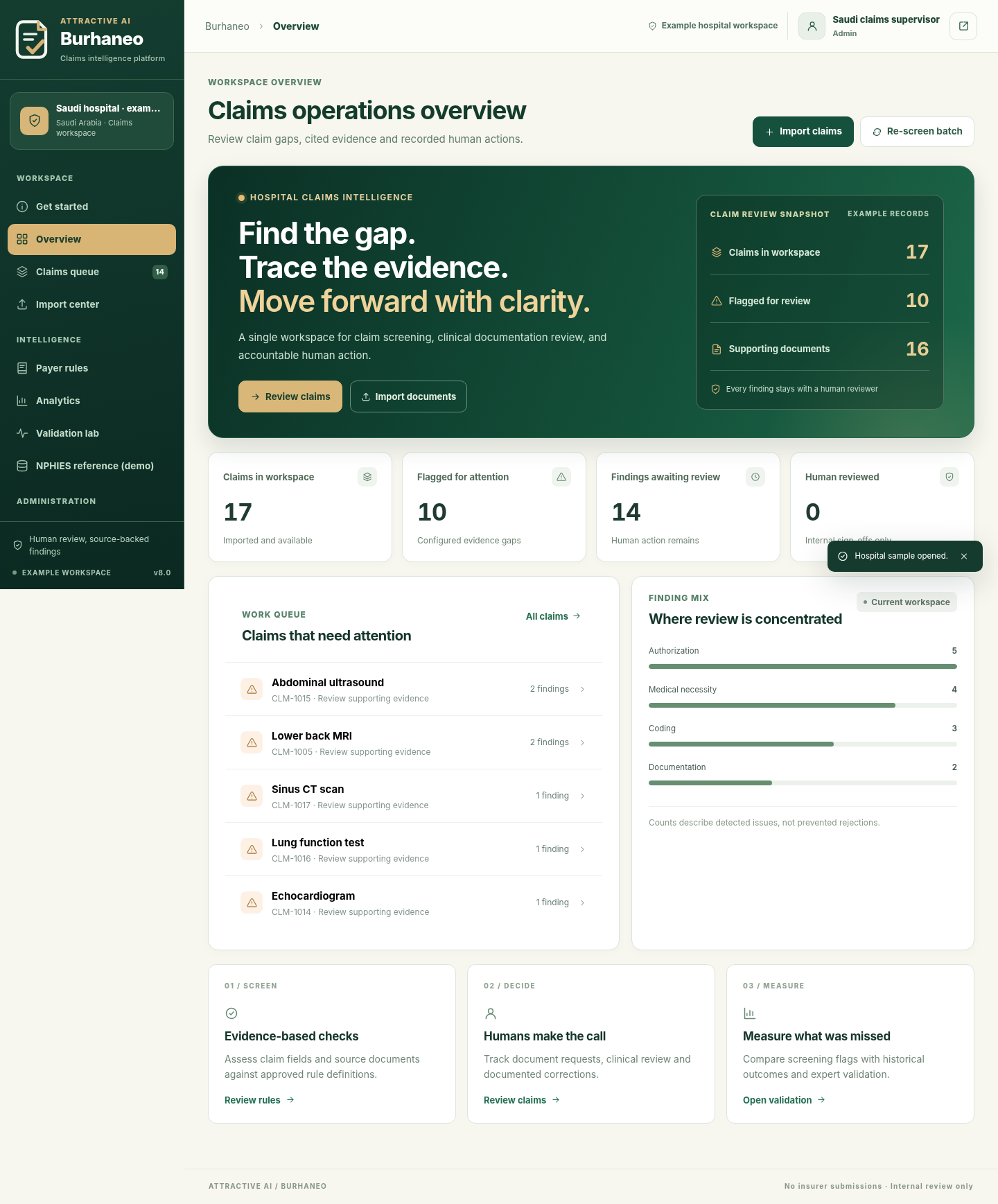
See how claims specialists can navigate a queue, inspect evidence, track follow-up and record review activity in a focused workspace.
Training accounts use fictional hospital records. Real integrations are not connected.
Different responsibilities. The same need for clear evidence and accountable action.
Find issues early, prioritize review and document the action taken.
See exactly where supporting medical evidence or coding information needs another look.
Understand review workload and model its potential financial impact transparently.
Burhaneo is intended to fit around approved hospital workflows. Specific interfaces must be scoped, authorized and tested before they're called connected.
Hospital record and encounter data, where interfaces allow.
Structured claims and clinical documents for defined testing workflows.
Public FHIR references inform technical design; live access requires credentials.
Versioned policy rules need authorized sources and clinical review.
Short, specific answers about clinical oversight, integrations, data handling and what the product can actually do today.
View all questions →Burhaneo is designed to review claims and supporting documents before submission, flag potential evidence gaps, show the reason and source, and help staff decide what to investigate or correct.
No. It does not approve claims, make insurer decisions, or submit claims in the current demonstration. Authorized staff remain responsible for review and any subsequent workflow.
No. A reduction in denials or administrative costs would need to be demonstrated with a specific provider, payer mix and independently evaluated outcomes.
Each finding is intended to include a rule reference, a specific source passage and document page when supporting text is available, or an explicit notice when the evidence cannot be found. A missing passage is not proof that care did not occur.
No. It can flag evidence that may be missing relative to a configured criterion. The clinical interpretation and determination remain with qualified reviewers and the payer as appropriate.
For an initial retrospective evaluation: appropriately authorized and de-identified claims, relevant clinical documents, applicable payer criteria, and expert-reviewed expected findings. A pilot would also need an approved security and data-handling arrangement.
Not live. The current development work includes selected educational FHIR structural checks. Actual NPHIES connectivity requires approved integration, credentials and end-to-end testing.
The integration strategy depends on the hospital’s environment and approved interfaces. Production integrations are not claimed as connected until tested with the specific system.
The product roadmap includes Arabic user interfaces, right-to-left layouts and mixed-language clinical-document processing. Actual Arabic accuracy and supported formats must be validated before operational use.
Without a source, a rule or a clear explanation of uncertainty, a claim warning is just another notification.
Burhaneo shows review signals. Hospital specialists remain accountable for the decision and any external claim action.